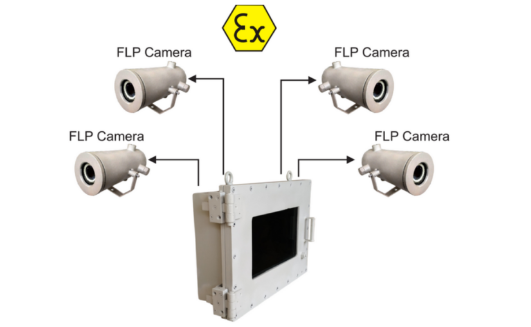
Hazardous industrial locations such as petrochemical plants, refineries, gas terminals, offshore rigs, paint and coating facilities, fertilizer processing, and solvent handling environments require continuous visual monitoring for operational and safety integrity. Standard CCTV cameras cannot be used in such environments due to risk of ignition from electrical sparks, IR LED heat, and internal component failure.
Flameproof (Ex d) CCTV cameras are engineered to contain internal ignition and prevent flame propagation outward, ensuring safe monitoring in Zone 1 and Zone 2 hazardous atmospheres.
For foundational knowledge of zone definitions: A Comprehensive Guide to Zone 0, Zone 1, Zone 2 & Zone 3 – Read here
See detailed explanation of protective concepts:
Parameter | Zone 1 | Zone 2 |
Certification | Ex d IIC T6 Gb mandatory | Ex d / Ex nR / Ex e acceptable |
Wiring | Armoured cable with barrier glands | Armoured double-compression |
Internal volume safety | Must contain an explosion | Reduced requirements |
Maintenance interval | Higher | Standard |
Camera type | Ex d fixed or PTZ | Ex d / Ex nR fixed |
Explore certified housings: Explosion-Proof Camera Enclosure
IR performance is critical for 24/7 monitoring.
In explosion-proof cameras, thick Ex d glass can reflect IR light back into the lens, causing glare and fogging. Flameproof Instrumentation has surmounted this challenge!
A Split-Window camera design physically separates the lens window from the IR LED window, using two separate optical panels.
Benefits include:
Lens Type | Best Application |
Fixed | Small rooms / indoor process |
Varifocal | Production floors / conveyor monitoring |
Motorized PTZ | Tank farms, jetty, silos, offshore towers |
Application | Recommended IR Range |
Indoor Zone 1 | 20–40 m |
Outdoor Refinery | 60–120 m |
Tank Farm / Jetty / Port | 120 m+ PTZ with IR boosting |
Analog cameras require:
Meaning:
IP PoE cameras use only one cable for both power and data, resulting in:
For Zone 1, this advantage is significant.
Camera Type | Description | Best Use Case |
Built-in Ex d Camera | Camera integrated inside flameproof body | New installations |
Ex d Enclosure System | Standard camera inside Ex d enclosure | Upgrades & retrofits |
PTZ Ex d Camera | Remote pan, tilt, zoom | Large outdoor monitoring |
Fixed Bullet Ex d | Static wide coverage | Corridor/entry area |
Browse enclosure solutions here: Explosion-Proof Camera Enclosure
Can I place a standard CCTV inside a flameproof enclosure?
Only if enclosure is certified and cable entry follows Ex d rules.
Is PTZ allowed in Zone 1?
Yes, if complete assembly is tested as Ex d.
Can I retrofit wiper later?
No. Must be certified as part of the camera assembly.
Selecting a flameproof CCTV camera is a critical engineering decision that affects real-time visibility, emergency response speed, compliance performance, and worker safety.
Evaluate certification, optical design, IR capability, material durability, PoE wiring advantages, and installation environment before finalizing equipment.
Explore certified industrial monitoring solutions here:Flameproof Camera Enclosure & CCTV Systems
