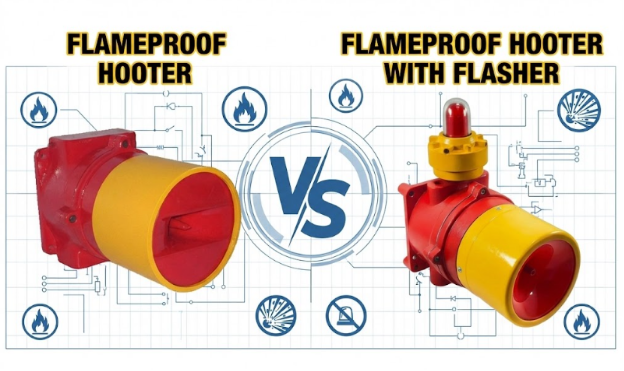
Emergency alert systems in hazardous industrial environments must overcome real-world challenges such as high background noise, visual obstructions, large distances, dust, fumes, and workers wearing hearing protection. In such conditions, selecting between a standard flameproof hooter and a flameproof hooter with a flasher directly impacts emergency response time and risk mitigation.
Use a standard flameproof hooter only in low-noise indoor rooms (below 80 dB) where line-of-sight visibility is clear, and personnel density is limited.
Use a hooter with a flasher (or jumbo flasher) in high-noise areas above 85 dB, outdoor plants, large open facilities, night-shift environments, and wherever workers use ear protection. In most Zone 1 hazardous area installations, dual signaling (audio + visual) is considered best engineering practice in India.
If any of the questions below are answered yes, a hooter with a flasher is the recommended choice:
Checklist Question | |
| |
| |
| |
| |
| |
|
If three or more Yes responses → Choose hooter with flasher.
A flameproof hooter (Ex d) is an audible alarm device designed for hazardous areas containing flammable gases or vapours. The enclosure contains any internal ignition, preventing flame propagation outside the enclosure.
Explore certified industrial options: Standard Flameproof Hooters
A hooter with a flasher combines high-intensity sound with powerful visual signaling using LED beacon or jumbo flasher modules. These are designed for conditions where sound alone may not ensure adequate warning coverage.
Explore variants:
International safety guidelines specify:
An audible alarm must be at least 15 dB louder than the surrounding ambient noise to be perceived clearly.
Example:
In this situation, audible signal is borderline effective, and adding a flasher becomes engineering necessity, not preference.
Area Type | Conditions | Recommendation |
Control rooms & MCC | Low noise (<70 dB) | Standard hooter |
Laboratories & analyser cabins | Limited movement | Standard hooter |
Indoor manufacturing rooms | Clear acoustics | Standard hooter |
Explore options: Standard Ex d Hooter
Area Type | Factors | Recommended Solution |
Tank farms, jetty terminals, refineries | Wind, fog, distance | Hooter + Jumbo flasher |
Compressor rooms, boiler rooms | >100 dB | Flasher mandatory |
Outdoor processing units | Night visibility | Strobe flasher |
Workers with ear protection | PPE | Hooter + flasher |
Hazardous Zone 1 | Highest response need | Hooter + flasher |
Explore models: Hooter with Flasher
Flasher Type | Day Visibility | Night Visibility |
Standard beacon | 100–150 m | 250–300 m |
Jumbo flasher | 250–350 m | 600+ m |
Dual-colour LED | 300+ m | 700+ m |
Model | Sound Output | Flasher Type | Best For |
Basic Flameproof Hooter | 95–110 dB | None | MCC rooms, indoor cabins |
Hooter with Standard Flasher | 110 dB | LED Beacon | Indoor & mid-size production floors |
Hooter with Jumbo Flasher | 110–120 dB | High-intensity LED | Outdoor tank farms, jetty areas, LPG handling |
In 2024, a Gujarat refinery upgraded 42 sound-only hooters to 110 dB hooters with jumbo flashers after a gas leak was not detected by nearby operators due to compressor noise.
Response time reduced from more than four minutes to under 40 seconds.
The upgrade was recommended during an internal safety audit aligned with IS 2189 fire system guidelines.
Learn more about hazardous zones: Hazardous Area Classification Guide
Is a flameproof hooter with a flasher mandatory in Zone 1?
Not legally mandatory, but widely recommended during PESO inspections and considered best practice under IS 2189 and NFPA 72.
How far can a jumbo flasher be seen in daylight?
Up to 350 metres, depending on atmospheric conditions and mounting height.
Do flashers increase power consumption significantly?
Typically 8–15 W additional load, negligible compared to the safety impact.
Can a flasher be retrofitted to an existing hooter?
No. The assembly must be tested and certified as a single unit.
Ideal mounting height?
Generally 2.5–3 m indoors and 4–5 m outdoors, considering line of sight.
Selecting between sound-only hooters and hooters with flashers must be based on objective plant conditions rather than device cost. In most modern hazardous environments, especially Zone 1 outdoor process areas, dual-mode signaling significantly improves emergency response and reduces risk. For lower-noise indoor areas, standard flameproof hooters remain efficient.
Explore complete flameproof signaling solutions and certified models used across India’s critical industries: Visit Flameproof Industrial Safety Solutions
